Korean skincare manufacturers: how the industry works and how to vet a factory
Korea has over 4,000 registered cosmetics manufacturers, from large ODM groups to small labs, plus agents who resell their capacity. Here is who fits which brand, and what to check before you sign.
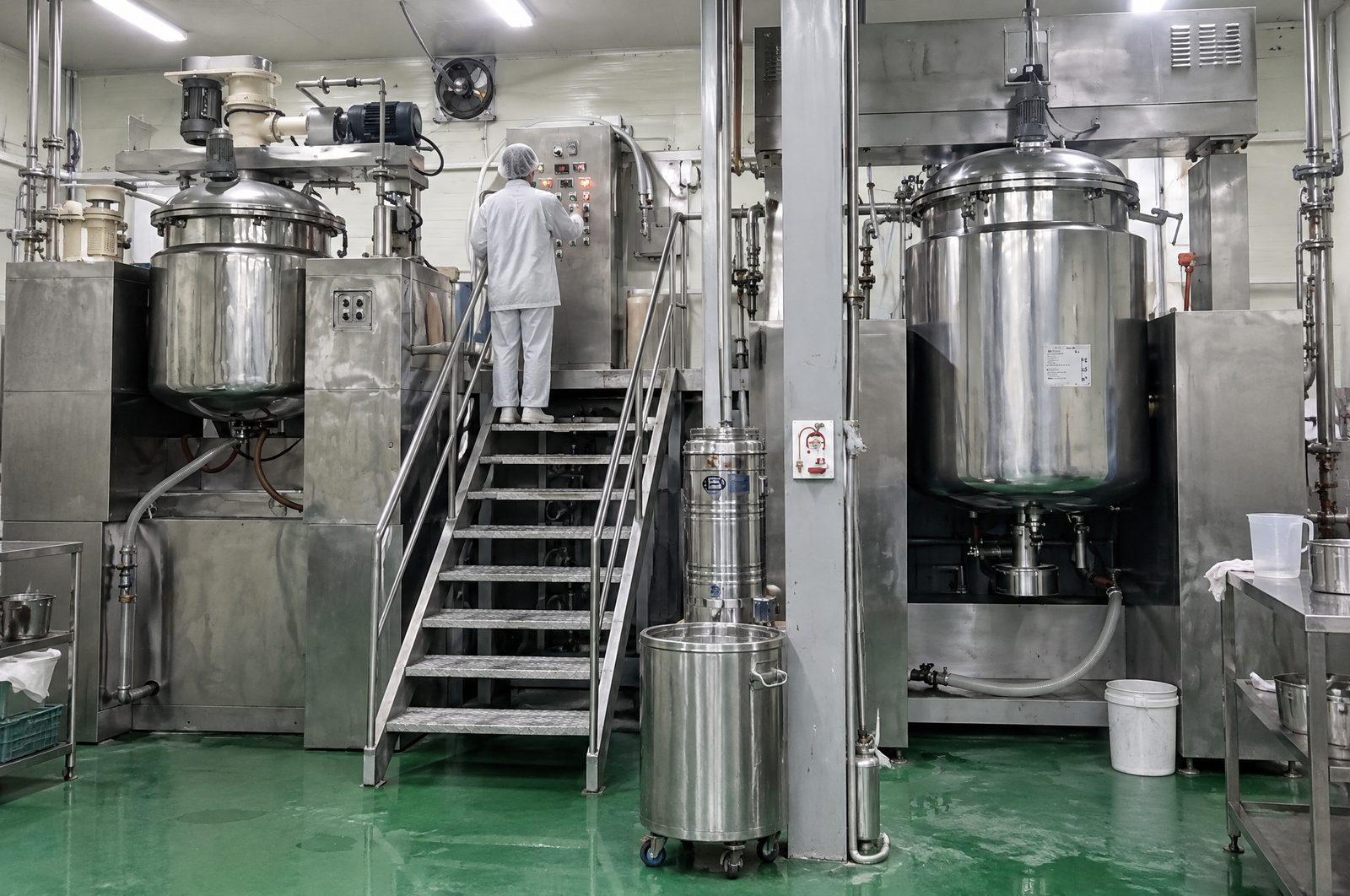
Korean skincare manufacturers come in four kinds: large ODM groups (such as Cosmax, Kolmar Korea and Cosmecca Korea), mid-size OEM factories, small labs, and trading agents who resell factory capacity. The right one depends on your budget, minimum order and how much control you need. Before you pay anyone, check three things: MFDS registration, ISO 22716 and FDA registration.
How the Korean skincare industry is structured
Korean law splits the industry into two kinds of registered business. A cosmetic manufacturing business actually makes products, and labeling or secondary packaging alone does not count. A responsible cosmetic distribution business puts products on the market and answers for their quality and safety, but it can have them made by someone else. Both register with the Ministry of Food and Drug Safety (MFDS) under Article 3 of the Cosmetics Act.
The gap between the two is wide. At the end of 2025, MFDS counted 4,158 registered cosmetic manufacturers and 28,412 responsible distribution businesses. So most companies that sell Korean cosmetics have them made by someone else, and a company that offers to "manufacture" for you may be one of them.
At the top sit the ODM groups, which develop and make products for other brands. In MFDS figures for 2025, the three largest ODM producers by value were Cosmax, Kolmar Korea and Cosmecca Korea, and Cosmax alone reported about 1.6 trillion won of production. Below them sit thousands of smaller Korean cosmetic manufacturing companies, from mid-size factories to small labs, and around all of them a layer of agents and sourcing platforms.
The four kinds of Korean skincare manufacturers
Each group suits a different stage of a brand. The ranges below are typical, not rules, so always confirm the minimum for your exact product and packaging.
| Type | Typical minimum | Suits | Watch for |
|---|---|---|---|
| Large ODM group | Set per project | Brands with volume and a development budget | Small first orders compete with big programs |
| Mid-size OEM factory | Often 1,000 to 5,000 units | Scaling a proven product | Custom packaging minimums on top |
| Small lab or small-run OEM | Often 100 to 1,000 units | First launches and tests | Whether your batch is filled on a GMP line |
| Trading agent or platform | The factory's minimum | One contact for many factories | Not knowing who fills your product |
Large ODM groups
Original design manufacturers develop the formula and then make it, so you can arrive with a brief instead of a finished formula. The large groups work at a scale few others match. They make sense when you have volume, a development budget and time for several rounds of samples. If you are launching a first product, ask early what minimum they would accept and who would manage an account your size.
Mid-size OEM factories
This is the broad middle of the industry: registered factories with their own filling lines, a library of tested formulas and usually a lab that can adjust them for you. They suit brands that already sell a product and want a lower unit cost at a few thousand units.
Small labs and small-run OEMs
Small labs fill a few hundred units, often from their own library formulas, and they are the fastest route to a first product. Ask whether your batch is filled on a GMP certified line or on a bench in a back room. A small-run Korean skincare OEM manufacturer sits a step above, with runs from about 500 units and the documents an export market expects. KoreanOEM works in this band: 500 units for most skincare, made in an ISO 22716 certified, FDA registered factory.
Trading agents and sourcing platforms
Agents do not fill product themselves. They match you with a factory, translate, follow up and sometimes pool small orders. A good agent saves you time across languages and time zones. A poor one hides the factory, adds a margin you cannot see and leaves you without the facility details you need for an FDA listing or an EU safety file.
Which type fits your brand
- First product, a budget of a few thousand dollars: a K-beauty private label manufacturer that runs small batches, with a library formula and a stock container. At KoreanOEM a serum starts from $3.70 per unit at 500 units, or $1,850 in goods before decoration, tests and freight.
- A proven product you want to scale: a mid-size factory, or ask your current maker for its price breaks at 3,000 and 5,000 units.
- A new active, texture or claim that no library offers: an ODM, mid-size or large, with a development fee and several rounds of samples.
- You already own a formula: an OEM that will check it against your market's rules and fill it to your specification.
- No budget for inventory yet: white label or dropshipping. Read white label vs private label skincare before you choose, and see low MOQ private label skincare for how small a first run can be.
How to vet a Korean skincare manufacturer
Five checks catch most problems. Ask for each document in writing, then compare the company names and addresses across all of them: they should match the site that will make your product.
- MFDS manufacturing registration. Every skin care products manufacturer in South Korea needs a cosmetic manufacturing business registration, issued by a regional MFDS office. The certificate shows the registration number, the company name, the factory address and the type of manufacturing. If your contact holds only a distribution registration, ask which registered factory will fill your product.
- ISO 22716 certificate. ISO 22716 is the international guideline for cosmetics GMP, covering production, control, storage and shipment. ISO does not certify anyone itself; independent certification bodies do. Check the issuer, the site address, the scope and the expiry date, and confirm accredited certificates in the IAF CertSearch database or with the issuer.
- Korean CGMP. MFDS also has its own cosmetics GMP standard, called CGMP, which it recommends rather than requires, and it publishes a list of compliant sites. Treat it as a plus, not a must.
- FDA facility registration, if you sell in the US. Under MoCRA, a foreign facility that makes cosmetics for the US must register with FDA and renew every two years, unless it qualifies as a small business. Following ISO 22716 does not exempt it. You will need the facility registration number for your own FDA product listing, so ask for it early.
- Samples and a real contact. Order samples against a written brief and judge texture, scent and the ingredient list against it. Notice who answers: the person who will run your project, or a salesperson who has to ask the factory every time.
Our 12 questions to ask a skincare manufacturer turn these checks into an email you can send.
Samples, contracts and formula ownership
The contract matters more than the brochure. Before you pay a deposit, get these points in writing.
- Formula ownership. Library formulas usually stay with the manufacturer, while a formula developed for you can be assigned to you. Ask whether you get only the INCI list, or the full formula and the right to have it made elsewhere.
- Exclusivity. If your product starts from a shared base, is your adjusted version exclusive, and in which markets?
- The approved sample as the standard. Production should match the sample you signed off in look, scent and texture, within agreed tolerances.
- Tests and documents. Which stability, challenge and patch tests are included, and which documents ship with each batch.
- Payment and timing. A deposit on order and the balance before shipment is normal. Full prepayment before you have approved a sample is not.
For reference, at KoreanOEM lab samples ship in 10 to 14 days from the brief, custom formulas stay the client's, every client receives the full INCI list, and nothing is produced until the client approves the sample.
Red flags
- "FDA approved" or an "FDA registration certificate". FDA does not approve cosmetics before sale (color additives aside), does not issue registration certificates, and says a registration number does not mean approval.
- "KFDA approved". Korea's regulator was renamed from KFDA to MFDS in 2013, so the badge is more than a decade out of date.
- No factory name or address, or documents that show three different companies.
- An ISO certificate you cannot trace to a certification body, or one issued for another site.
- Full payment up front, before samples are approved.
- One all-in price with no split between formula, packaging, decoration, tests, documents and freight.
- Drug claims on cosmetics. In the US, sunscreens and products that claim to treat acne are regulated as drugs.
- Pressure to skip stability or challenge testing to save a few weeks.
Why brands make skincare in Korea
Scale and export practice. Korea exported $11.4 billion of cosmetics in 2025, 11.8% more than in 2024, and became the world's second-largest cosmetics exporter after France, according to MFDS. Skincare made up about three quarters of those exports.
The United States became the largest market for Korean cosmetics in 2025, at $2.2 billion, ahead of China and Japan, and Korean products reached 202 countries. For a brand abroad, that means many factories are used to export paperwork, English labels and foreign rules.
The trade-offs are distance, time zones, several weeks of sea freight and the import rules of your own market. None of them is a reason to avoid Korea, but all of them belong in your plan. If you want to hold us to the checklist above, ask for samples and see the documents we prepare.
Frequently asked questions
Who are the biggest skincare manufacturers in Korea?
What is the minimum order for Korean skincare manufacturing?
How do I check that a Korean cosmetics factory is legitimate?
Is FDA registration the same as FDA approval?
Do I own the formula if a Korean manufacturer develops it for me?
Sources
- MFDS press release, May 22, 2026: 2025 cosmetics production, exports and registered businesses (Korean)
- Cosmetics Act of Korea, English translation (Korea Legislation Research Institute)
- Enforcement Rule of the Cosmetics Act, English translation
- MFDS: Cosmetics GMP and list of compliant sites (Korean)
- MFDS: History
- ISO 22716:2007, Cosmetics, Good Manufacturing Practices (GMP)
- ISO: Certification
- FDA: Registration and Listing of Cosmetic Product Facilities and Products
- FDA: Guidance for Industry, Registration and Listing of Cosmetic Product Facilities and Products
- FDA: Cosmetics Importers