White label vs private label skincare: what each means and which one to choose
Both put your brand on a product someone else makes. The difference is how much you can change, and whether anyone else sells the same thing. Here is a side-by-side, and a path from one to the other.
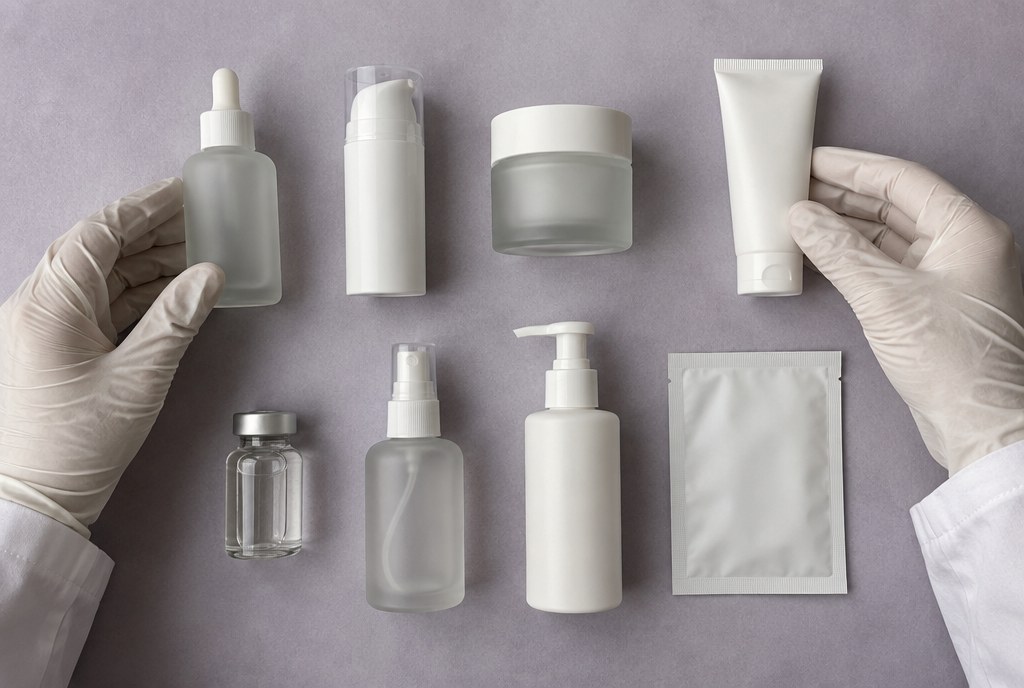
The difference in white label vs private label skincare is control. White label is a finished product sold unchanged to many brands, each under its own label. Private label is made for your brand: you adjust the formula and packaging, and no one else sells your version. White label is faster and cheaper; private label is yours to shape.
What white label skincare means
A white label product already exists. The manufacturer developed the formula, chose the bottle and keeps it in production, and it sells the same product to any brand that orders it. You pick from a catalog, send your logo, and the product ships with your label on it.
That makes white label quick and cheap to start. Minimums run from a single unit on print-on-demand programs to a few hundred on stock lines, and there is nothing to develop. The catch: you cannot change the formula, the scent or usually the container, and nothing stops a competitor from selling the same product under another name.
The two terms are used loosely, and some suppliers call a fixed catalog product "private label". Judge an offer by what you can change and what is exclusive to you, not by its name.
What private label skincare means
Private label starts from a formula the manufacturer already has, often called a library or base formula, and makes your version of it. You can usually adjust actives, scent or texture within what the base allows, choose the container and decoration, and put your brand on all of it.
Your version, packaging and label are yours. The base may still sit inside other brands' products, which is normal as long as your adjusted version is exclusive to you.
Minimums are higher than white label, usually 500 to 1,000 units per product, and a first run takes a couple of months rather than a couple of weeks. At KoreanOEM, a serum made from a library formula starts from $3.70 per unit at 500 units, or $1,850 in goods for that first run, and drops to an estimated $2.96 per unit at 1,000 units. White label spreads its cost over each order instead, which is why its unit price stays higher.
A formula developed from scratch for you is custom ODM work rather than private label. Our guide to OEM vs ODM vs private label covers that wider picture.
White label vs private label, side by side
Here is the private label vs white label skincare difference on the points that matter most.
| Factor | White label | Private label |
|---|---|---|
| Formula | Fixed, sold as is | Adjusted from a library base |
| Exclusive to you | No | Your version and packaging |
| Minimum order | 1 to a few hundred units | Usually 500 to 1,000 units |
| Time to launch | Days to a few weeks | About 2 to 3 months |
| Unit cost | Higher | Lower, and falls with volume |
| Cash up front | Small | The whole first run |
| Formula owner | The manufacturer | The manufacturer, for a shared base |
| Legal duties (US) | You, if your name is on the label | You, if your name is on the label |
The last row matters most: buying a finished product does not buy you out of the responsibility for it.
Who owns what, and who answers for it
In both models you own your brand name, your artwork and your customer relationships. What differs is the formula: a white label formula always belongs to the manufacturer, and so does a shared private label base, while a formula developed for you can be assigned to you by contract. At KoreanOEM, custom formulas stay the client's and every client receives the full INCI list.
Legal responsibility follows the label, not the formula. In the US, MoCRA makes the "responsible person" the manufacturer, packer or distributor whose name appears on the label. When your label reads "Distributed by" or "Manufactured for" followed by your company, that is you. The responsible person must report serious adverse events to FDA within 15 business days, keep records that substantiate the product's safety, and list each product with FDA unless a small business exemption applies.
The EU works the same way through its responsible person, who must be established in the EU, keep a product information file for ten years after the last batch, and notify each product through the CPNP portal before sale. A good manufacturer prepares most of that file, but the duty sits with the name on the pack.
What exclusivity really covers
Exclusivity is the main thing private label buys you, so pin it down. It can cover the formula as adjusted for you, the combination of formula and packaging, or only your artwork. It can apply worldwide or in named markets and sales channels, and it can run for a set period or for as long as you keep ordering.
Write it into the contract in plain words: which formula version (by code and INCI list), which markets and for how long. A manufacturer may reasonably tie long exclusivity to a yearly volume. What you should not expect is exclusivity on a shared base, because sharing bases is how small runs stay affordable. If you need a formula nobody else can ever use, that is custom development.
When each one makes sense
White label fits when
- You want to test demand for a product type before committing to a production run.
- You need an add-on, such as a hand cream for a gift set or sachets for an event.
- You need product in weeks, not months.
- Your business is built on something other than the formula, such as a service, a salon or a community, and the product supports it.
Private label fits when
- You want reviews and repeat orders to build on a product only you sell.
- You need a specific texture, scent, active or claim.
- You sell on marketplaces, where an identical product under another brand competes on price alone.
- Your volumes are high enough that a lower unit cost changes your margin.
For how small a private label run can be, see low MOQ private label skincare. White label is often paired with dropshipping when you want to sell without holding stock, and private label skincare dropshipping covers that model and its rules.
How to move from white label to private label
- Learn from the white label product. Collect what customers say about texture, scent, size and results, and keep its ingredient list as a benchmark.
- Brief a manufacturer with that benchmark and the changes you want, and ask for samples of two or three library bases side by side.
- Test before you switch. The new formula needs its own stability testing in the container you chose.
- Update the paperwork. If you keep the product name but change the formula, the ingredient list on the label changes. In the US, update or add the FDA product listing, which includes the ingredients. In the EU, update the safety report and the CPNP notification.
- Time the handover. Sell through the white label stock while the first private label run is made and shipped. At KoreanOEM, a library formula in stock packaging takes about 10 weeks from brief to delivery.
- Keep what still works. Some brands keep a white label item or two, such as a travel size or a gift, after the core line has moved.
Questions that tell you which one you are buying
- Is this exact formula sold to other brands?
- Can I change the actives, scent or texture, and what does a change cost?
- Is my version exclusive, in which markets, and is that in the contract?
- Who owns the formula if I pay for development?
- Do I get the full INCI list and the stability and challenge test results?
- What is the minimum for the formula, the container and the print, separately?
- Whose name goes on the label, and who prepares the FDA listing or CPNP notification?
For the factory documents worth asking for as well, see how to vet Korean skincare manufacturers.
If you want to compare a library base with your current white label product, ask for samples and put them side by side.
Frequently asked questions
What is white label skincare?
What is private label skincare?
Is white label or private label cheaper?
Can I switch from white label to private label later?
Who is legally responsible for a white label product?
Sources
- FDA: Modernization of Cosmetics Regulation Act of 2022 (MoCRA)
- FDA: Small Businesses and Homemade Cosmetics, Fact Sheet
- FDA: Registration and Listing of Cosmetic Product Facilities and Products
- Regulation (EC) No 1223/2009 on cosmetic products (EUR-Lex)