Private label skincare dropshipping: how it works, the real trade-offs and when to hold stock
Dropshipping lets you sell skincare under your brand without holding inventory. It also makes you answerable for a product you never touch. Here is the honest math, the rules and a middle path.
Private label skincare dropshipping means a supplier keeps its formulas in stock, puts your label on them when an order comes in and ships straight to your customer. You pay per order and hold no inventory. The trade-offs are thinner margins, slower shipping, little control over the product, and full legal responsibility for anything carrying your name.
How private label skincare dropshipping works
Private label cosmetics dropshipping follows the same steps for skincare and makeup:
- You pick products from the supplier's catalog, usually a fixed set of formulas in fixed containers.
- You design a label, often on the supplier's template, and sometimes a box.
- You connect your online store or marketplace account to the supplier's app.
- A customer orders from you and pays your price.
- The order passes to the supplier, who charges you for the product, the labeling, the packing and the postage.
- The supplier labels, packs and ships; you handle customer service and returns.
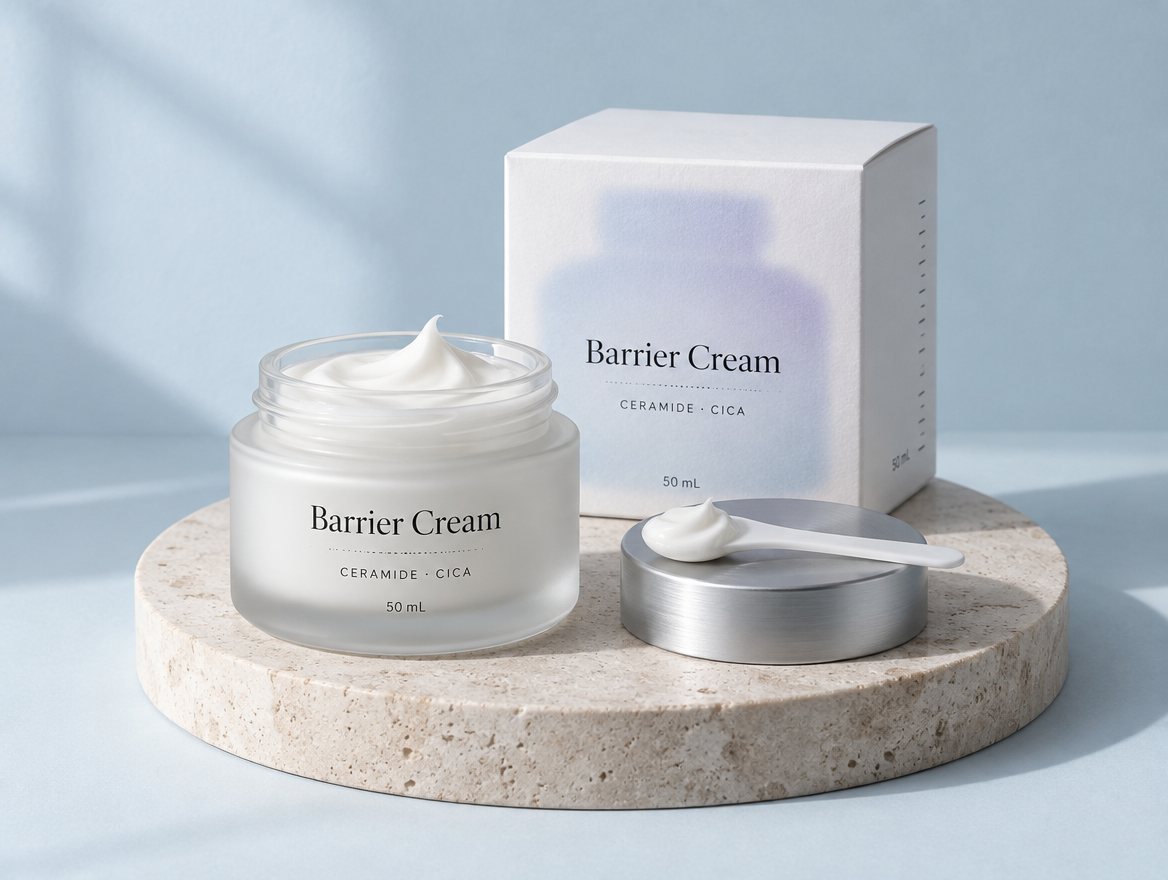
Most programs are white label skincare dropshipping in practice: the formula and the bottle are the supplier's, and only the label is yours. Some suppliers also offer a hybrid, where you buy a small batch of pre-labeled stock that they store and ship for you. That is closer to owning inventory, with the supplier acting as your warehouse.
The real advantages
- Almost no cash in stock. You pay for each unit after your customer has paid you.
- Fast to start. With a ready catalog and a label template, a store can go live in days.
- Cheap experiments. You can test a product type or an audience without a production run.
- No warehouse, no packing table and no postage contracts.
For a creator with an audience, or a salon or spa testing retail, that is a reasonable way to learn what sells before committing money to inventory.
The real disadvantages
Margins
The supplier's per-unit price covers the product plus storage, small-lot labeling, packing and handling, so it sits well above a factory unit price. You still pay for ads, payment fees, returns and any free shipping you promise. Run the numbers with your real cost of winning a customer before you commit.
Shipping times and duties
Delivery depends on where the supplier ships from. Parcels from a warehouse in your customer's country can arrive in days; parcels that cross a border take longer and can be held at customs. For US customers, duty-free de minimis treatment for imports worth $800 or less is suspended for all countries, and as of 2026 CBP collects applicable duties on shipments valued up to $2,500, apart from narrow exceptions such as genuine gifts of $100 or less.
Shipping promises are regulated too. Under the FTC's Mail, Internet, or Telephone Order Merchandise Rule, you need a reasonable basis for any shipping time you state, or for shipping within 30 days if you state none. If an order will be late, you must tell the customer and offer the option to cancel for a full refund.
Product control
You cannot change the formula, the container or the fill size, and unless your agreement says otherwise, a supplier can switch a raw material or a bottle without asking you. Stockouts on your best seller hit your reviews, not theirs.
Differentiation and marketplaces
The same formula can be sold by many brands, so you compete on story and price. Marketplaces add their own rules: Amazon's drop shipping policy requires you to be the seller of record, keeps any third party off the packing slips, invoices and packaging, and makes you responsible for returns and customer service.
Your name on the label means the legal duties are yours
This is the part that matters most. In the US, the Modernization of Cosmetics Regulation Act (MoCRA) makes the "responsible person" the manufacturer, packer or distributor whose name appears on the label. On a dropshipped product sold under your brand, that is normally you. The responsible person must:
- report serious adverse events to FDA within 15 business days;
- keep records that substantiate the product's safety;
- list each product with FDA within 120 days of marketing it, including its ingredients and the registration number of the facility that makes it, and update the listing annually;
- make sure the label shows a US address, a US phone number or electronic contact information, such as a website, where adverse events can be reported (a requirement in force from December 29, 2024).
Small businesses with average US cosmetics sales under $1,000,000 a year over the previous three years (adjusted for inflation) are exempt from registration and listing, but not from adverse event reporting, safety records or labeling. The exemption does not apply to some products, such as those that regularly touch the mucous membrane of the eye.
Watch the catalog for drugs, too. In the US, sunscreens are regulated as drugs, and a claim such as treating acne turns a product into a drug with its own registration and labeling rules. Outside the US, the EU requires a responsible person established in the EU, a safety report and a CPNP notification before sale, and Great Britain requires a responsible person with a UK address and a notification to the Office for Product Safety and Standards. Our overview of exporting skincare market by market covers the rest.
Before you sign with any private label skincare dropshipping supplier, ask for the FDA registration number of the facility that fills each product, the full INCI list, stability and challenge test summaries, a batch code on every unit, and who will pass adverse event reports on to you. The factory checks behind those answers are covered in Korean skincare manufacturers: how to choose and vet one.
Dropshipping vs holding your own stock: the math
The two models differ line by line. Fill in this table with the supplier's price list and your warehouse's rate card, then compare the cost per order.
| Cost line | Dropshipping | Own stock at a 3PL |
|---|---|---|
| Product | Supplier's unit price, labeling included | Factory unit price, such as a KoreanOEM serum from $3.70 at 500 units |
| Freight and duty | Per parcel, if it crosses a border | Once per shipment, spread over the run |
| Fulfillment | Built into the supplier's fee | 3PL receiving, storage, pick and pack |
| Cash up front | Almost none | The run: $1,850 in goods for 500 serums |
| Control | Catalog formula, bottle and label | Your formula, packaging and inserts |
Start from your retail price and subtract each line per order, plus ad cost and payment fees. Do it for your best seller first: it is the product where a lower unit cost adds up fastest.
When to move to your own inventory
- One product sells steadily enough that a 500-unit run would sell through within a few months, well inside its shelf life.
- Reviews mention slow delivery, damaged parcels or packaging that looks generic.
- You want a texture, active, size or container the catalog does not offer.
- Your margin after ad costs is too thin to scale.
- You are entering a market that needs your own responsible person and documents anyway.
None of these means dropshipping was a mistake. It did its job: it showed you what sells.
The middle path: a small first run held at a 3PL
You do not have to jump from zero stock to thousands of units. A practical next step is to keep dropshipping the long tail while your best seller ships from your own small run.
- Brief the best seller as private label. Choose a library formula close to what your customers like, in a stock container. If you are unsure what changes, read white label vs private label skincare.
- Order a small run. At KoreanOEM, most skincare starts at 500 units, and smaller trial runs are possible for library formulas on request. Plan about 10 weeks from brief to delivery. Low MOQ private label skincare explains how to size the run.
- Ship to a 3PL in your market by air (about 5 to 10 days) or by sea (about 4 to 6 weeks). The shipment is a commercial import: imported cosmetics can be examined at entry, and products that appear adulterated or misbranded can be refused, so labels and documents must be right before it leaves.
- Connect the 3PL to your store, and keep the dropship supplier for the products you are still testing.
- Reorder in time. Reorders take 4 to 6 weeks plus freight, so reorder while a few months of stock remain.
Because KoreanOEM sells its own skincare in the US, we have been through US import and FDA MoCRA listing ourselves, and we prepare the MoCRA listing, the EU CPNP file or the UK SCPN paperwork for your market. When one product is ready to graduate, get a written quote for a small run.
Frequently asked questions
Is dropshipping private label skincare legal?
How long does skincare dropshipping take to deliver?
Can I dropship private label skincare on Amazon?
Do I need FDA registration to dropship skincare?
When should I stop dropshipping and hold inventory?
Sources
- FDA: Modernization of Cosmetics Regulation Act of 2022 (MoCRA)
- FDA: Guidance for Industry, Registration and Listing of Cosmetic Product Facilities and Products
- 21 U.S. Code 364e, Labeling (Legal Information Institute)
- FDA: Cosmetics Importers
- CBP: CBP modernizes low-value shipment processing (June 24, 2026)
- FTC: Business Guide to the Mail, Internet, or Telephone Order Merchandise Rule
- Amazon: How to dropship on Amazon
- Regulation (EC) No 1223/2009 on cosmetic products (EUR-Lex)
- GOV.UK: Making cosmetic products available to consumers in Great Britain