Private label skincare for estheticians: how to start your own line
Your clients already trust your advice. Here is how to turn it into a small, compliant product line: what to make first, what it costs and a realistic 10-week plan.
Private label skincare lets estheticians sell products under their own brand without building a lab. A manufacturer supplies tested formulas, packaging and compliant labels; you choose the routine and the name. Start with three to five products that match your treatments, order small first runs, keep every claim cosmetic, and plan about 10 weeks from brief to launch.
Why estheticians and spas launch their own line
A treatment room has a ceiling: there are only so many facials in a week. Products sell between appointments, online and on reorder, so a retail line adds revenue without adding hours.
The second reason is trust. Clients already ask what to use at home. When the answer is your own cleanser and serum, the purchase stays with you instead of going to a department store or a marketplace, and every bottle on a bathroom shelf carries your name.
The third is continuity. Home care that matches the treatment, such as a gentle cleanser and a barrier cream after a peel, keeps results visible between visits and gives clients a reason to rebook.
There are costs too. Stock ties up cash, the company named on the label becomes legally responsible for the products, and you still have to sell every unit. The rest of this guide is about keeping those risks small.
Choosing your first products
Build a core routine before anything clever. Many professional skincare lines for spas start with a cleanser, a serum and a moisturizer, then add one hero product tied to a signature treatment, such as a mask or an ampoule.
| Product | Role in the line | From, per unit | Minimum |
|---|---|---|---|
| Gel cleanser | Everyone needs one; fast reorders | $2.10 | 500 |
| Hydrating serum | Easy add-on after a facial | $3.70 | 500 |
| Cream | Daily use, steady reorders | $3.10 | 500 |
| Ampoule | Signature treatment at home | $4.95 | 500 |
| Sheet mask | Gifts and add-on sales | $0.55 | 1,000 |
These are KoreanOEM starting prices, which assume a library formula, a stock container and a one-color label. The full range of product types is worth a look before you decide.
Clients often ask for sunscreen after treatments, but in the US sunscreen is an over-the-counter drug with its own testing and labeling rules, so treat it as a second step. KoreanOEM quotes US sunscreen case by case.
Backbar versus retail sizes
Backbar products are the large bottles you use in the treatment room; retail products are the sizes clients take home. Many lines use the same formula for both and change only the container and label. If a size is intended only for use by licensed professionals, US law requires a clear and prominent statement on the label that it is to be used only by licensed professionals, on top of the usual label information. Retail sizes need the full consumer label. Our skincare packaging guide covers which containers suit which formulas.
Pricing and margin math
Start from the factory price, then add everything it takes to get the product onto your shelf.
- Factory price: at KoreanOEM a private label serum starts from $3.70 per unit at 500 units, or $1,850 for 500. At 1,000 units the estimate falls to about $2.96 per unit.
- Landed cost: add freight, any import duties and brokerage, packaging upgrades such as a printed box, and your share of samples and testing.
- Retail price: set it from your market, not from your cost. Look at what clients already pay for the professional brands on your shelf.
| Example: 500 serums | Amount |
|---|---|
| Factory cost, library formula | $1,850 |
| Your retail price (example) | $48 each |
| Retail value of the run | $24,000 |
| Sell-through at 10 a week | About 50 weeks |
Gross margin is the retail price minus the landed cost, divided by the retail price. Even after freight, duty, payment fees and a box, a professional retail price leaves a wide gap over the factory price. The real limit is sell-through: if 40 clients a week come through the door and one in four buys a serum, 500 bottles last about a year. Size the first run to your client list, not to the price break, and leave room for wholesale at about half of retail if other spas may stock your line later.
Keep every claim cosmetic
In the US, whether a product is a cosmetic or a drug depends on its intended use. A cosmetic cleanses, beautifies or changes appearance. A product intended to treat or prevent disease, or to affect the structure or function of the body, is a drug. The FDA judges intended use from your label, website, social media and advertising, from what customers expect, and from ingredients with a well-known therapeutic use.
FDA examples of drug claims include reducing cellulite, increasing or decreasing melanin production and regenerating cells, as well as anti-aging effects that involve the structure or function of the skin and treating acne, eczema or irritated skin. Acne treatments and sunscreens are regulated as over-the-counter drugs.
| Cosmetic wording | Drug wording to avoid |
|---|---|
| Brightens the look of dull skin | Reduces melanin production |
| Smooths the look of fine lines | Stimulates collagen, regenerates cells |
| Helps skin feel calm and comfortable | Treats eczema or irritated skin |
| Cleanses away excess oil | Clears acne and breakouts |
| Leaves skin looking firmer | Reduces cellulite |
Treatment menus, captions and before-and-after posts count as claims, so use the same wording everywhere. When in doubt, describe how skin looks and feels, not what the product does inside it.
Your duties under MoCRA
The company named on the label is the responsible person. It needs a US address, phone number or website on the label for adverse event reports, must report serious adverse events to the FDA within 15 business days, and must have evidence that each product is safe. Products must be listed with the FDA within 120 days of first being marketed, but small businesses with average annual US cosmetic sales under $1,000,000 over the previous three years (adjusted for inflation) are exempt from listing, unless they sell products that regularly contact the eye's mucous membrane, are injected, are for internal use or alter appearance for more than 24 hours.
Small first runs and samples
A first run should be small enough to sell through while the product is fresh and the branding still feels right. At KoreanOEM most skincare starts at 500 units per product and sheet masks at 1,000, and smaller trial runs are possible for library formulas on request. The same logic applies to any low MOQ private label skincare project.
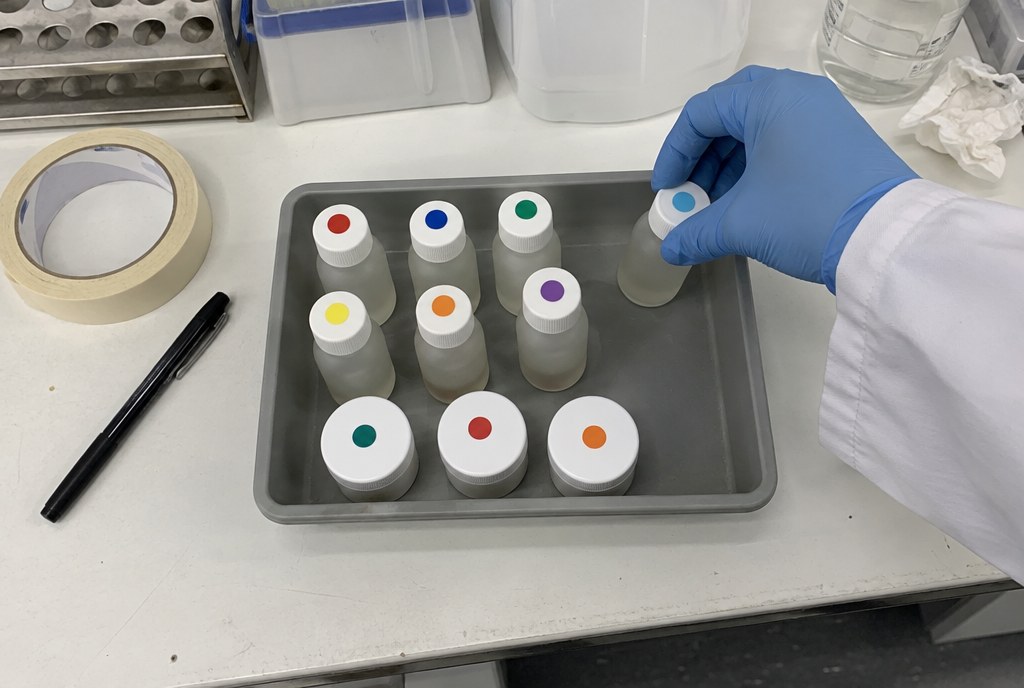
Samples come first. Lab samples ship in about 10 to 14 days from the brief, library formula samples are free for qualified projects, and custom samples carry a small development fee that is credited against the first order. Nothing goes into production until you approve the sample.
Use the samples as a pilot. Give them to 10 to 20 regular clients with three questions: how the texture felt, whether they liked the scent, and how their skin felt after a week. The answers tell you which formulas to keep and how to describe them. Request samples once your product list is clear.
How estheticians can start a skincare line in 10 weeks
With a library formula and stock packaging, about 10 weeks from brief to delivery is realistic. A custom formula takes 12 to 16 weeks.
- Week 1: write the brief (products, sizes, textures, scent or fragrance free, target retail price) and get a written quote, which arrives within one business day.
- Weeks 2 to 3: receive lab samples, test them yourself and with clients, and pick the formulas.
- Week 4: approve the samples, choose stock containers, send your logo and approve the label proofs. Pay the deposit; the balance is due before shipment.
- Weeks 5 to 8: production, with stability, challenge and patch tests planned in. Meanwhile, photograph the samples, build your shop page, add the products to your treatment menu and train staff.
- Weeks 8 to 10: shipping and customs. Air freight takes about 5 to 10 days; sea freight takes 4 to 6 weeks and suits reorders better.
- Week 10: launch to existing clients first, in the room and by email, then open online sales.
Reorders take 4 to 6 weeks, so reorder while about two months of stock is left.
Frequently asked questions
Can estheticians sell their own skincare products?
What products should an esthetician private label first?
How much does it cost to start a private label skincare line?
Do I need to register my skincare line with the FDA?
Can I use the same product in treatments and sell it to clients?
Sources
- FDA: Is It a Cosmetic, a Drug, or Both? (Or Is It Soap?)
- FDA: Cosmetics Importers (differences in cosmetic and drug definitions)
- FDA: Small Businesses and Homemade Cosmetics: Fact Sheet
- 21 U.S.C. 364e: Labeling, including cosmetic products for professional use
- 21 U.S.C. 364a: Adverse events
- 21 U.S.C. 364c: Registration and product listing
- 21 U.S.C. 364h: Small businesses
- 21 CFR Part 333, Subpart D: Topical acne drug products