K-beauty market 2026: the export data and what it means for new brands
Korea exported a record $11.4 billion of cosmetics in 2025, and the first half of 2026 grew 27.3%. Here are the official numbers, where the growth is, and what they mean for a new brand.
The K-beauty market is still growing, by Korea's official numbers. Cosmetics exports reached a record $11.4 billion in 2025 and $7.0 billion in the first half of 2026, up 27.3% (preliminary). The US became the largest buyer in 2025, and skincare made up 74.7% of exports. For a new brand that is evidence of demand, not a promise of sales.
Every figure below comes from national statistics published by Korea's Ministry of Food and Drug Safety (MFDS), compiled from customs data. They cover all cosmetics exported from Korea by every company, so read them as a picture of the category, not of any one brand.
The K-beauty market in 2026, in five numbers
| Measure | Figure | Period |
|---|---|---|
| Cosmetics exports | $11.4 billion, the highest on record | 2025 |
| World ranking | No. 2 exporter, after France | 2025 |
| Destinations | 202 countries, up from 172 | 2025 |
| Skincare share | 74.7%, or $8,532 million | 2025 |
| Exports so far this year | $7.0 billion, up 27.3% | January to June 2026, preliminary |
Growth is broad as well as fast. Korean cosmetics reached 30 more countries in 2025 than in 2024, and the second quarter of 2026, at $3.9 billion, was 25.8% above the first quarter's $3.1 billion.
Ten years of K-beauty exports
Exports are now about 2.7 times what they were in 2016. The one dip came in 2022, when they fell from $9.2 billion to $8.0 billion, and new highs followed in 2024 and 2025.
Korea's cosmetics exports by year, in US dollars. Source: MFDS, May 22, 2026 (2020 to 2025) and July 2, 2026 (2016 to 2019).
The first half of each year tells the same story: $4.05 billion in 2022, $4.07 billion in 2023, $4.80 billion in 2024, $5.50 billion in 2025 and $7.00 billion in 2026, the highest first half on record. More charts, including product types and the top ten markets, are on our export data page.
Where K-beauty is growing fastest
The largest markets and the fastest growing ones are not the same. Among the 20 largest destinations in 2025, these grew fastest:
| Market | 2025 exports | Change on 2024 |
|---|---|---|
| Poland | $282 million | +111.7% |
| France | $134 million | +73.2% |
| United Arab Emirates | $286 million | +67.2% |
| United Kingdom | $230 million | +53.8% |
| Canada | $186 million | +52.2% |
| Australia | $166 million | +48.7% |
| Netherlands | $138 million | +42.8% |
In the first half of 2026 the Netherlands (+220.4%) and the UK (+150.6%) grew fastest among the ten largest destinations, and Poland moved up to seventh place with $251 million (+72.8%), all preliminary.
China went the other way. Exports there fell 19.0% in 2025 to $2,018 million, and another 6.6% in the first half of 2026. The growth has shifted toward North America, Europe and the Gulf.
The US is now the largest K-beauty market
In 2025 the US passed China for the first time, taking $2,184 million of Korean cosmetics, up 15.0%. In the first half of 2026 it took $1,449 million, up 41.5%, or 20.7% of all exports. Four years earlier, in the first half of 2022, the US share was 10.9%.
US import data points the same way. Citing US International Trade Commission figures, The Korea Herald reported that Korea passed France in 2024 as the largest source of US cosmetics imports, with $1.701 billion against France's $1.263 billion.
What the numbers mean for a new brand
Skincare is where the demand is
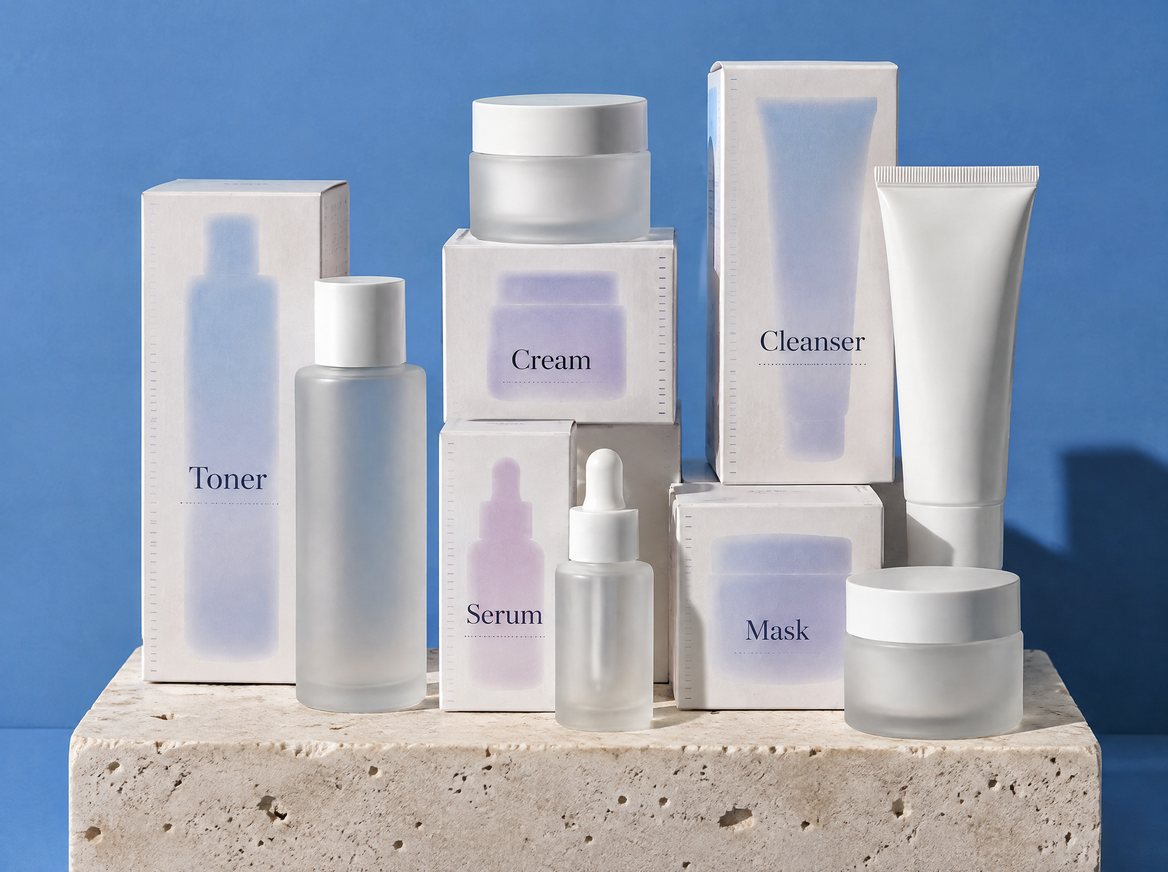
Three quarters of Korea's cosmetics exports are skincare. In the first half of 2026, skincare exports grew 25.0% while makeup fell 4.2%. A first line built around a serum, a cream or a mask sits in the part of the category that is growing.
Choose your first market on purpose
The US is the largest market. Europe, Canada, Australia and the Gulf are growing fastest, from smaller bases. Each has its own paperwork: an FDA MoCRA listing in the US, a CPNP notification with an EU Responsible Person in the EU, and an SCPN notification in the UK. Our export guide covers what each market asks for.
Growth brings competition
A growing category attracts new brands, so "Korean" on its own is not a position. Decide early what makes yours different: the audience you serve, the product, the price or the story. Our view on what Korean labs do well is in why Korean skincare is so good.
Budget for landed cost, not factory price
A factory price is only part of what a unit costs you. For goods shipped from Korea to the US, freight, the 12.5% duty and customs clearance come on top, and card or marketplace fees come off every sale. Work through one product before you order; our article on skincare margins by channel shows the math line by line.
Keep the first run small
You do not need thousands of units to test a market. At KoreanOEM a private label serum starts from $3.70 per unit at 500 units, lab samples take about two weeks, and a library formula reaches you in about 10 weeks. Reorders take 4 to 6 weeks, so you can scale with sell-through instead of guessing. If you are still deciding where to manufacture, see Korean vs Chinese vs US manufacturers.
What the export data does not tell you
- It is not retail sales. Export values are what goods were worth when they left Korea, not what shoppers paid.
- It includes everyone. The totals include the largest Korean brands and their contract manufacturers, so they say little about how a small new label will do.
- The 2026 figures are preliminary. First-half numbers can be revised when the annual statistics come out.
- Markets can shrink. China was the largest destination until the US passed it in 2025, and exports there fell in 2025 and again in early 2026.
- Rules and tariffs move. US duty on Korean skincare changed several times in 2025 and 2026.
Used with those limits in mind, the data is a useful guide to where shoppers already buy Korean skincare, and where they have started to.
Frequently asked questions
How big is the K-beauty market?
Which country buys the most Korean cosmetics?
Is K-beauty still growing in 2026?
Is it too late to start a K-beauty brand?
Sources
- MFDS: 2025 cosmetics production and export statistics (May 22, 2026, in Korean)
- MFDS: First half 2026 cosmetics exports, preliminary (July 2, 2026, in Korean)
- The Korea Herald: K-beauty exports cross $11b milestone in 2025 (January 11, 2026)
- The Korea Herald: S. Korea becomes top cosmetics exporter to US, surpassing France (April 24, 2025)
- USTR: Action in the forced labor Section 301 investigations (July 2026)
- USITC: Harmonized Tariff Schedule, 3304.99.50