How to pick, check and trademark a skincare brand name
Choose a name you can own, search it the way an examiner will, and file in the right classes before you print labels. Official fees as of 2026.
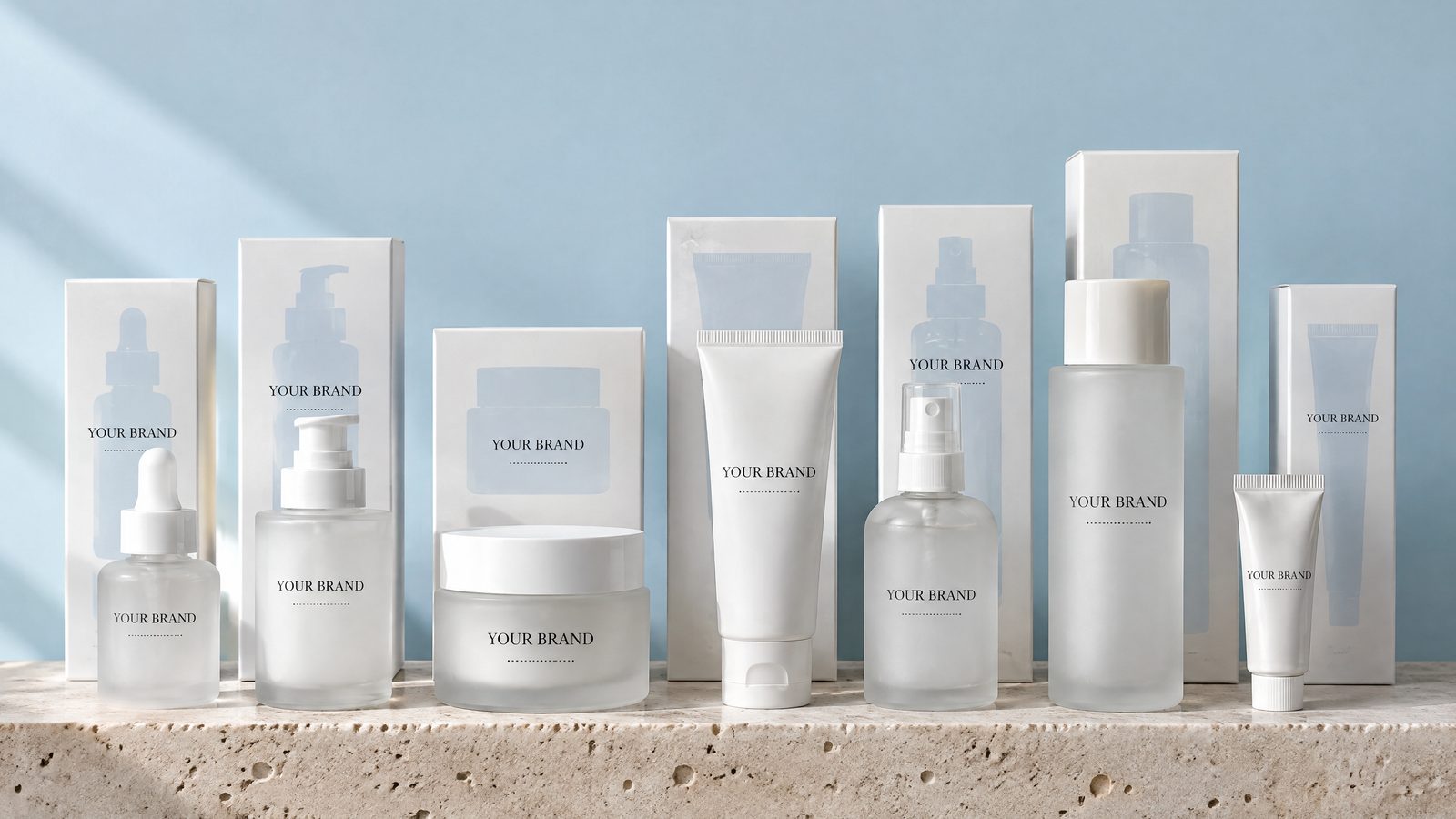
To trademark a skincare brand name, pick a distinctive name, search it in the official database of each market, then file with that market's trademark office in Class 3 (cosmetics) and, if it fits your business, Class 35 (retail and online store services). In the US that office is the USPTO, in the UK the UK IPO and in the EU the EUIPO.
Why the name comes before the label
Your name ends up on every bottle, box and barcode record, so changing it later is expensive: new artwork, new printing and new barcodes, because under GS1 rules a change of primary brand needs a new product number. Marketplaces care too. Amazon Brand Registry asks for a pending or registered trademark and a logo with the brand name on the product or its packaging.
Pick a name you can protect
The USPTO sorts names from strong to weak. Invented words, real words with no link to skincare, and names that only hint at a quality are strong. Names that describe the product, such as "Hydrating Serum Co.", are weak and often refused, and generic words cannot be registered at all.
- Say it out loud, spell it after hearing it once, and check what it means in the languages of your markets.
- Check that the domain and social handles you want are free.
- Stay well clear of names that sound like a known beauty brand.
Search before you commit
These official databases are free to search.
| Market | Official search | What it covers |
|---|---|---|
| United States | USPTO Trademark Search | Federal registrations and pending applications |
| United Kingdom | UK IPO: search for a trade mark | UK trade marks |
| European Union | EUIPO eSearch plus and TMview | EU trade marks; TMview adds the participating national and international offices |
| Worldwide | WIPO Global Brand Database | International marks under the Madrid System and trademarks from participating national and regional offices |
Search the exact name, spelling variants, sound-alikes and translations. A mark does not have to be identical to block yours: the USPTO refuses a mark that is confusingly similar to an earlier one for related goods, and this "likelihood of confusion" is the most common reason for refusal.
Look in Class 3 first, then in related classes such as 5 (medicated products), 21 (cosmetic utensils) and 44 (beauty care services). Search the web and the big marketplaces as well: the USPTO notes that even marks that are not federally registered can prevent you from using or registering yours. An attorney's clearance search goes further and comes with an opinion.
Choose your classes
Offices charge per class, so file the classes you will actually use. Class names below follow the Nice Classification, 2026 version.
- Class 3: non-medicated cosmetics and toiletry preparations. This is the core class for serums, creams, cleansers and masks.
- Class 35: advertising and retail services, including online stores. Brands with their own web shop, or plans to sell other brands, often add it; an attorney can tell you if it is worth the fee for you.
- Class 44: beauty care services, for salons and estheticians who also treat clients.
- Class 5 or 21: medicated products (5), and brushes and other cosmetic utensils (21), if you sell them.
What filing costs and how long it takes
Official fees and timings as of 2026, before any attorney fees.
| Office | Official fee | Opposition window | Typical timing |
|---|---|---|---|
| USPTO (US) | $350 per class, filed online | 30 days after publication | 4.2 months on average to a first examination, 9.7 months to registration or abandonment |
| UK IPO (UK) | £205 for one class online, £60 per extra class | 2 months after publication | About 3 to 4 months if there are no issues |
| EUIPO (EU) | €850 for one class online, €50 for the second, €150 for each class after that | 3 months after publication | Registered after the opposition period if no opposition succeeds |
- US surcharges: $100 per class if the application lacks information, $200 per class for typing your own description instead of choosing one from the USPTO's ID Manual, and $200 for each extra 1,000 characters.
- Living outside the US: you must be represented at the USPTO by a US-licensed attorney.
- UK Right Start: pay £125, plus £30 per extra class, to have the application checked first, then the same again to continue.
- Keeping it: UK and EU registrations last 10 years and can be renewed. A US registration also needs maintenance filings to stay live.
USPTO timings are its reported averages, updated August 2026. EU marks cover every EU member state in one registration.
Selling in more countries: the Madrid System
Once you have filed at home, WIPO's Madrid System lets you extend the same mark to other member countries with one application in English, French or Spanish and one set of fees in Swiss francs. It covers 133 countries through 117 members. The basic fee is 653 Swiss francs (903 for a mark in color), plus a fee for each country you name.
Each country examines the mark under its own law and can refuse it within 12 months, or 18 in some cases. For the first five years, the international registration depends on your home filing: if that is refused or cancelled, the international registration falls with it.
Fit it into your launch
- File early. With a library formula and stock packaging we plan about 10 weeks from brief to delivery, while a US registration averages 9.7 months. Most brands launch with the application still pending, which is normal.
- Use the right symbol. In the US you can use ™ from the start. Use ® only once the mark is registered, and only for the goods in the registration.
- Amazon. Brand Registry accepts a pending application from the trademark office of a country with an Amazon store.
- One owner. File in the name of the company that will sign your orders and own your barcodes, so the records match.
Frequently asked questions
Do I need a trademark to sell skincare?
Which trademark class is skincare?
How much does it cost to trademark a skincare brand?
How long does it take to register a trademark?
Can I use the TM symbol before my trademark is registered?
Sources
- USPTO: Search our trademark database and Likelihood of confusion
- USPTO: Strong trademarks and What is a trademark (TM and ® symbols)
- USPTO fee schedule: trademark fees
- USPTO: Hiring a U.S.-licensed attorney
- USPTO: Trademark processing wait times and Trademark process
- GOV.UK: Register a trade mark (fees, Right Start, timeline)
- EUIPO: Fees payable direct to the EUIPO and Opposition
- WIPO: Global Brand Database
- WIPO: Madrid System, Madrid System FAQs and Madrid Protocol, Article 6
- WIPO: Nice Classification, 13th edition, version 2026 (class headings)
- GS1 GTIN Management Standard: primary brand change
- Amazon Brand Registry: enrollment requirements