Cosmetic stability testing: what it checks, how long it takes and how shelf life reaches the label
Stability testing decides whether a formula survives shipping, shelves and bathrooms, and which date or symbol goes on the pack. Here is how it works, from test conditions to the challenge test and costs.
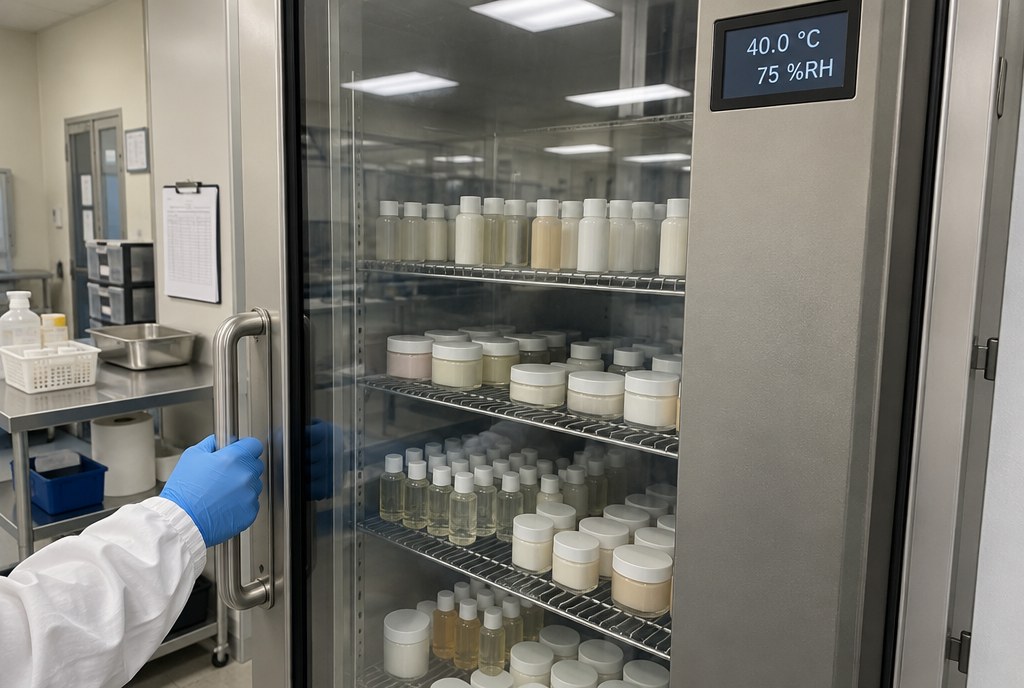
Cosmetic stability testing stores samples of a finished product in its final packaging under heat, cold, freeze and thaw cycles and light, then checks appearance, color, odor, pH, viscosity, separation and the pack at set intervals. No law prescribes a single protocol; accelerated studies often run one to three months, alongside a 28-day preservative challenge test.
What stability testing checks
The Cosmetics Europe guideline describes the goal as making sure a new or changed product keeps its intended physical, chemical and microbiological quality, its function and its looks when stored under appropriate conditions. In practice the lab measures a set of properties at the start, again at each time point, and compares them with the specification.
| Property | What the lab looks for |
|---|---|
| Appearance and color | Yellowing, darkening, cloudiness, crystals |
| Odor | Fading fragrance, or off notes from oils oxidizing |
| pH | Drift outside the specification, which can weaken preservatives or actives |
| Viscosity and texture | Thinning, thickening, graininess |
| Separation | Oil or water on top, sediment; a centrifuge gives an early warning |
| Weight | Water lost through the pack |
| Packaging | Clogged pumps, cracks, distortion, labels that wrinkle, corroded tube linings |
| Actives | The level of sensitive actives such as vitamin C, where a claim depends on it |
Microbial safety runs on a separate track, the challenge test, covered below.
Common test conditions, and why none is mandatory
ISO/TR 18811, the ISO technical report on cosmetic stability, deliberately does not set conditions or pass criteria. Because products and storage vary so much, it leaves the manufacturer to specify and justify the protocol. The Cosmetics Europe guideline takes the same line: standard stability tests cannot be prescribed.
Most protocols still combine several of these:
| Condition | Typical example | What it reveals |
|---|---|---|
| Heat | 37, 40 or 45 °C for 1 to 3 months | Faster chemical change, separation, color and odor drift |
| Room temperature | About 25 °C | The baseline to compare against |
| Cold | About 4 to 5 °C | Thickening, clouding, crystals |
| Freeze and thaw | Cycles between minus 5 and 25 °C | Broken emulsions, crystals, pack damage |
| Light | Daylight or lamps through the pack | Fading and loss of light-sensitive actives |
| Transport | Vibration, drops, air freight cycles | Leaks, loose closures, powders separating |
The samples go into the final packaging, made of exactly the same materials as the one you will sell, with a glass jar as a control. Where there are several sizes, the smallest is tested, and packs are often stored upright, upside down and on their side. If you sell several scents, include the riskiest ones, because fragrances interact with a formula more than color shades do.
How long it takes, and what accelerated testing can predict
An accelerated study commonly runs 8 to 12 weeks, with checks at points such as 2, 4, 8 and 12 weeks. Formulators use rules of thumb to translate the result, for example that 8 weeks at 45 °C stands in for about a year at room temperature. Treat those as screening shortcuts: Cosmetics Europe notes there is very little generally applicable published research behind specific accelerated methods for predicting cosmetic shelf life.
Heat speeds up many changes, such as oxidation and color drift, so it flags weak formulas early. It can also mislead: a balm can soften at 45 °C in a way it never would on a shelf, and slow changes may not show up at all. That is why the guideline recommends confirming the prediction with real-time monitoring: production samples kept at room temperature and checked over the full claimed shelf life, while the product is already on sale.
Stability testing also does not cover what happens once customers open the product and put fingers in it. That is the job of the challenge test.
The challenge test (ISO 11930)
A challenge test, or preservative efficacy test, deliberately contaminates the product and measures what the preservative system does. Under ISO 11930, samples are inoculated with five microorganisms (Pseudomonas aeruginosa, Staphylococcus aureus, Escherichia coli, the yeast Candida albicans and the mold Aspergillus brasiliensis) and counted at 7, 14 and 28 days.
Results are judged against two sets of criteria. Criterion A, the stricter one, asks among other things for bacteria to drop by at least 3 log (99.9%) within 7 days with no regrowth. A product that only meets criterion B needs extra justification, such as packaging that limits contamination, like a pump instead of a jar.
The standard does not apply to products judged microbiologically low risk under ISO 29621, and it is designed mainly for water-based or water-miscible products. In the EU the results of the preservation challenge test belong in the product safety report. Allow 28 days of testing plus preparation and reporting; one US lab quotes 6 to 8 weeks in total.
From test results to the label: best-before date or PAO
In the EU, and in Great Britain under the same rule, the shelf life you can support decides what goes on the pack:
- 30 months or less: a best-before date, introduced by the words "best used before the end of" or the hourglass symbol.
- More than 30 months: no date is required, but the pack shows the open-jar symbol with the period after opening (PAO) in months, such as 12M.
- Exceptions: the PAO is not needed where it is not relevant, such as single-use products, packs that keep the product away from outside air, like aerosols, and low-risk formulas.
The PAO depends on how the product is used: a pump exposes the formula less than a wide jar, and the PAO assessment can take that into account. In the US, no law requires cosmetics to carry a shelf life or expiration date, but the FDA treats setting shelf life as the manufacturer's responsibility, and products that are also drugs, such as sunscreens, must be stability tested and carry expiration dates. For the rest of the label and the market filings, see our guide to FDA MoCRA and CPNP.
What stability testing costs
Prices vary by lab, and by how many conditions, time points, measurements and packaging variants you ask for. As a sense of scale, two small independent labs that publish prices in 2026 list a standard 12-week stability study at £285 (UK) and $800 (US). The US lab charges $1,200 when the study runs in your final packaging and $1,200 per round for a challenge test, while larger labs quote per project.
What multiplies the bill: each extra pack size or material, each fragrance variant, extra time points, assays for actives, and repeats after a failure. A failed test is the most expensive line of all, because it costs weeks as well as fees.
When a manufacturer runs the tests, they should appear as separate lines in your quote, not hidden in the unit price. At KoreanOEM the written quote itemizes formula, packaging, decoration, tests, documents and freight, and the lab page describes the tests we plan in.
How a manufacturer plans these tests
- Fix the packaging early. Stability data belongs to the pack it ran in, so the final bottle, pump and cap go on test, not a stand-in.
- Start on the approved sample. Heat, cold, freeze and thaw and light storage begin as soon as the formula is approved, with a glass control alongside.
- Run the challenge test in parallel. It needs 28 days of testing, so it should not wait for stability to finish.
- Patch test. A patch test on volunteers checks skin tolerance before launch.
- Confirm at scale. Samples from a batch made on production-type equipment are checked, because scale-up can change viscosity and texture.
- Keep retained samples. Production samples stay at room temperature and are checked over the shelf life you claim.
At KoreanOEM stability, challenge and patch tests are planned into the schedule from the start, which is part of why a custom formula takes 12 to 16 weeks from brief to delivery. For the full development sequence, see how custom skincare formulation works, and for pack choices, our packaging options.
Frequently asked questions
How long does cosmetic stability testing take?
What temperature is used for accelerated stability testing?
Is stability testing required by law?
What is the difference between stability testing and a challenge test?
How much does cosmetic stability testing cost?
Sources
- Cosmetics Europe and CTFA: Guidelines on Stability Testing of Cosmetic Products, 2004
- ISO/TR 18811:2018, Cosmetics: Guidelines on the stability testing of cosmetic products
- ISO 11930:2019, Cosmetics, Microbiology: Evaluation of the antimicrobial protection of a cosmetic product
- Regulation (EC) No 1223/2009 on cosmetic products (Article 19, Annex I, Annex VII)
- Cosmetics Europe: Guidelines on Cosmetic Product Labelling, 2011
- Colipa: Guidelines for compliance with the period after opening requirement, 2004
- OPSS: Regulation 1223/2009 and the Cosmetic Products Enforcement Regulations 2013, Great Britain
- FDA: Shelf Life and Expiration Dating of Cosmetics
- FDA: Modernization of Cosmetics Regulation Act of 2022 (MoCRA)
- Intertek: Cosmetic stability testing and storage conditions
- Perry Romanowski: Cosmetic Chemist's Guide to Stability Testing (UL Prospector)
- Innacos Labs: testing prices and ISCA Cosmetic Testing: stability tests