Custom skincare formulation: how a formula gets developed, how long it takes and who owns it
A custom formula is built from your brief instead of adapted from one the lab already makes. Here is the process, a realistic timeline, a brief template and the traps that cost brands months.
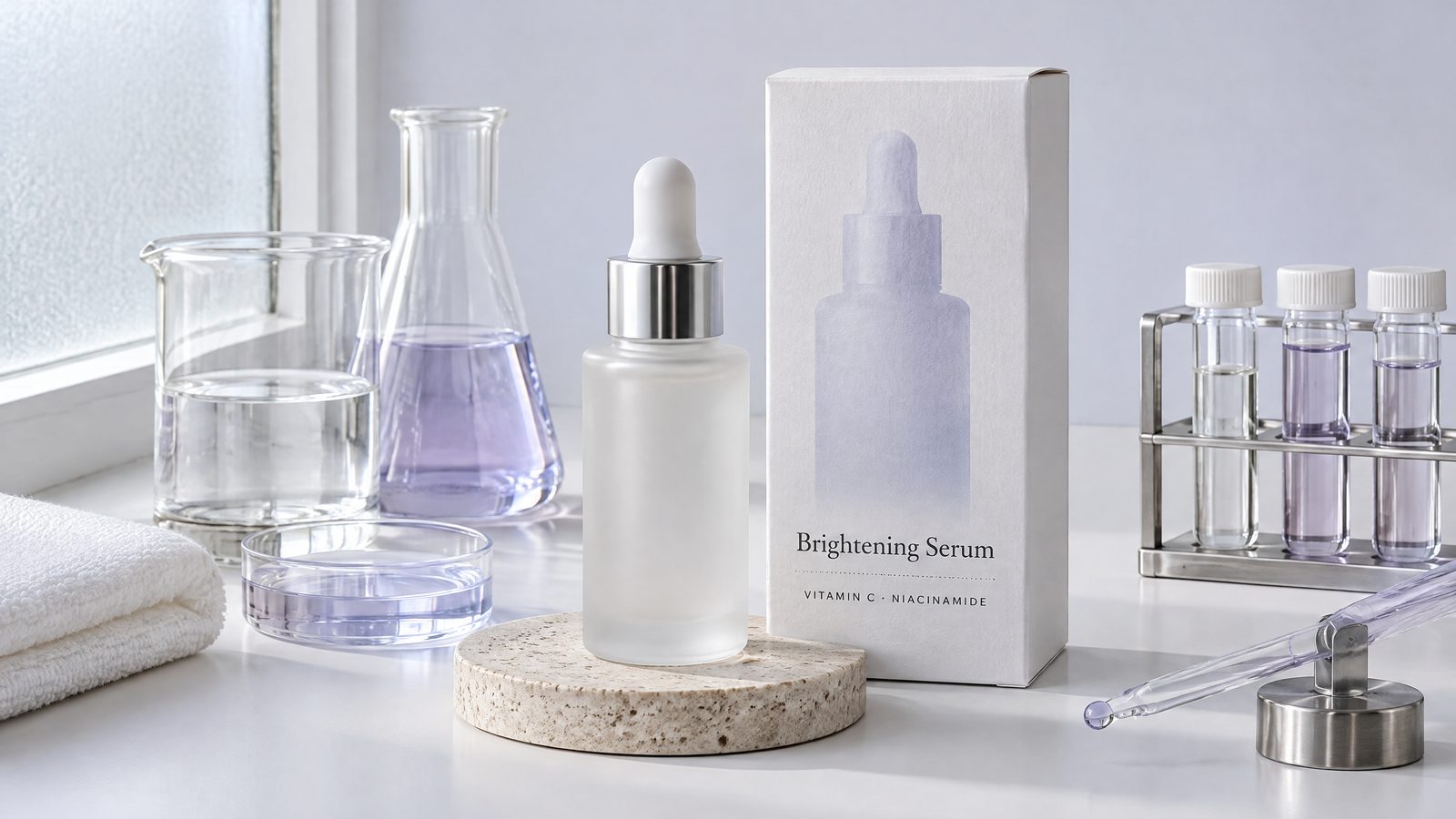
Custom skincare formulation means a lab develops a new formula from your brief instead of adjusting one it has. The work runs from brief and benchmark to lab samples, revisions, stability and packaging tests, a challenge test and a pilot batch. At KoreanOEM a custom formula takes 12 to 16 weeks from brief to delivery, and it stays yours.
Custom formula or library formula?
Most manufacturers offer two routes. A library formula is a base the lab already makes, which you adjust for texture, scent or active level and sell under your brand. A custom formula starts from a blank page: your benchmark, your claims, your free-from list. Here is how the two routes compare in our own projects.
| Library formula | Custom formula | |
|---|---|---|
| Starting point | A base the lab already makes | Your brief and benchmark |
| Samples | Free for qualified projects | Small fee, credited against the first order |
| Brief to delivery | About 10 weeks with stock packaging | 12 to 16 weeks |
| The formula belongs to | The lab | You |
A middle route is common: start from a library base and change one or two things. Ask whether your changes are small enough to keep the existing test data or big enough to need new stability work, because that decides the timeline. For the vocabulary factories use, see OEM vs ODM vs private label.
Go fully custom when the texture or hero claim you want does not exist in any library, when a retailer asks for an exclusive formula, or when your free-from list rules out the standard bases.
The development process, step by step
Every formulation lab works a little differently, but skincare product development at a manufacturer usually follows these steps.
- Brief. You describe the product, customer, claims and price (template below). The manufacturer checks feasibility and sends a written quote; ours takes one business day.
- Benchmark. One to three products you like, with notes on what to keep and what to beat. A benchmark settles more questions than any adjective.
- First lab samples. The chemist builds the base, adds the actives and sets the preservative system. First samples ship in about two weeks (10 to 14 days) from the brief.
- Revisions. You test on real skin and send specific written feedback. Each round repeats part of the sample cycle, so clear notes save weeks.
- Stability and packaging compatibility. The approved sample goes into your final packaging and through heat, cold, freeze and thaw cycles and light, then is checked for changes. Here is what cosmetic stability testing involves.
- Challenge test. A preservative efficacy test, usually to ISO 11930, shows whether the preservative system copes with bacteria, yeast and mold over 28 days.
- Safety. A patch test on volunteers; for the EU, a safety report that includes the stability and challenge results; for the US, records that substantiate safety under MoCRA.
- Pilot batch and approval. A batch made on production-type equipment shows whether texture and viscosity survive the scale-up, and you approve a sample before production.
- Production, QC and documents. Bulk is made, tested, filled and shipped with the documents your market needs.
How long custom formulation takes
Our custom projects take 12 to 16 weeks from brief to delivery, against about 10 weeks for a library formula in stock packaging. Stability, challenge and patch tests are planned into that schedule from the first week, not bolted on at the end.
What pushes a project past the plan is rarely chemistry. It is usually one of these:
- more revision rounds than planned, often because feedback was vague;
- a packaging change after testing started, which means repeating compatibility work;
- a failed challenge test, which means adjusting the preservative system and running another 28-day test;
- custom packaging with its own lead time;
- sea freight, about 4 to 6 weeks, where air takes 5 to 10 days.
Reorders are much faster, about 4 to 6 weeks, because the formula, test data and artwork already exist.
What a good brief contains
A good brief fits on one page and answers the questions a chemist would otherwise send you one email at a time. Use this as a template:
- Product and format: for example a 30 mL serum in an airless pump, or a 50 mL gel cream in a jar.
- Customer and skin type: who it is for and what bothers them about today's options.
- Benchmarks: one to three products, with what to match and what to beat.
- Hero ingredients: the actives you want, target levels if you have them, and why. Some need extra care, as our guide to a PDRN serum shows.
- Claims: the exact words you want on the box, so tests can be planned for them.
- Texture, finish and scent: watery, gel or rich; dewy or matte; fragrance-free or a scent direction.
- Free-from and certifications: for example fragrance-free, vegan, or ingredients your customers avoid.
- Markets: the US, EU, UK or others, which decide the allowed ingredients, labels and documents.
- Price: the retail price and the landed cost per unit you can afford.
- Quantity and timing: the first run, expected reorders and your launch date.
- Non-negotiables: the two or three things you will not trade away.
What custom formulation costs
The cost has two layers: developing the formula once, and making each unit. At KoreanOEM development is a small fee for custom samples, credited against your first order, so it is not lost if you go ahead.
The unit price then depends on the formula's real ingredients, the container, decoration and quantity. For comparison, a serum on a library formula with a stock container and a one-color label starts from $3.70 per unit at 500 units; a custom formula is priced on what is actually in it, and minimums follow the product type.
Testing is the other line to plan. Stability, challenge and patch tests are part of the plan; anything beyond that, such as clinical tests for a claim, depends on your claims and markets. The written quote itemizes formula, packaging, decoration, tests, documents and freight. Independent labs and consultants price development very differently, so compare itemized quotes, not headline numbers.
Who owns the formula?
Ask this before you brief anyone, not after the first order. At KoreanOEM custom formulas stay the client's, and every client receives the full INCI list. With a library formula you buy product made on the lab's base, and the base stays with the lab.
Know what the INCI list is and is not. It names the ingredients, those above 1% in descending order of weight, with no percentages, supplier grades or process steps. The full formula has all of those. Agree in writing:
- that the formula is yours and will not be sold to another brand;
- which documents you receive, and when;
- what you get if you move production, such as the quantitative formula and raw material specifications;
- confidentiality in both directions;
- who owns the stability, challenge and safety data generated for your product.
Common pitfalls
- Adjectives instead of benchmarks. "Luxurious but light" means something different to every chemist.
- Changing the packaging late. Stability data belongs to the pack it ran in, and the Cosmetics Europe guideline says to test in packaging made of exactly the same materials as the one you will sell.
- Treating the lab sample as final. A beaker and a production tank do not mix the same way, which is why the pilot batch and your sample approval come before production.
- Deciding claims after production. "Clinically shown" needs a study planned in advance, and EU rules require claim evidence that is relevant to the product and the benefit claimed.
- Picking active levels for the label. A headline percentage the formula cannot keep stable is worse than a modest one that stays put.
- Forgetting market rules. Products placed on the EU market after 31 July 2026 must name an expanded list of fragrance allergens above 0.001% in leave-on products, and in the US a sunscreen is an over-the-counter drug.
- Too many products at once. Every custom formula needs its own samples and tests, so launch one hero first.
If you have a benchmark and a rough brief, see how the lab works or send it with a quote request. The written quote comes back within one business day.
Frequently asked questions
How long does custom skincare formulation take?
How much does it cost to develop a custom skincare formula?
Do I own my custom skincare formula?
Can a lab copy a product I like?
What is the minimum order for a custom formula?
Sources
- Cosmetics Europe and CTFA: Guidelines on Stability Testing of Cosmetic Products, 2004
- ISO 11930:2019, Cosmetics, Microbiology: Evaluation of the antimicrobial protection of a cosmetic product
- Regulation (EC) No 1223/2009 on cosmetic products (Annex I safety report, Article 19 labelling)
- Commission Regulation (EU) No 655/2013 on common criteria for cosmetic claims
- Commission Regulation (EU) 2023/1545 on labelling of fragrance allergens
- FDA: Modernization of Cosmetics Regulation Act of 2022 (MoCRA)