Private label PDRN serum: what PDRN is, what the evidence shows and how it is made
PDRN went from Korean clinic injections to serums, ampoules and creams. Here is what it is, what the studies do and do not show, and how to make and label your own PDRN serum honestly.
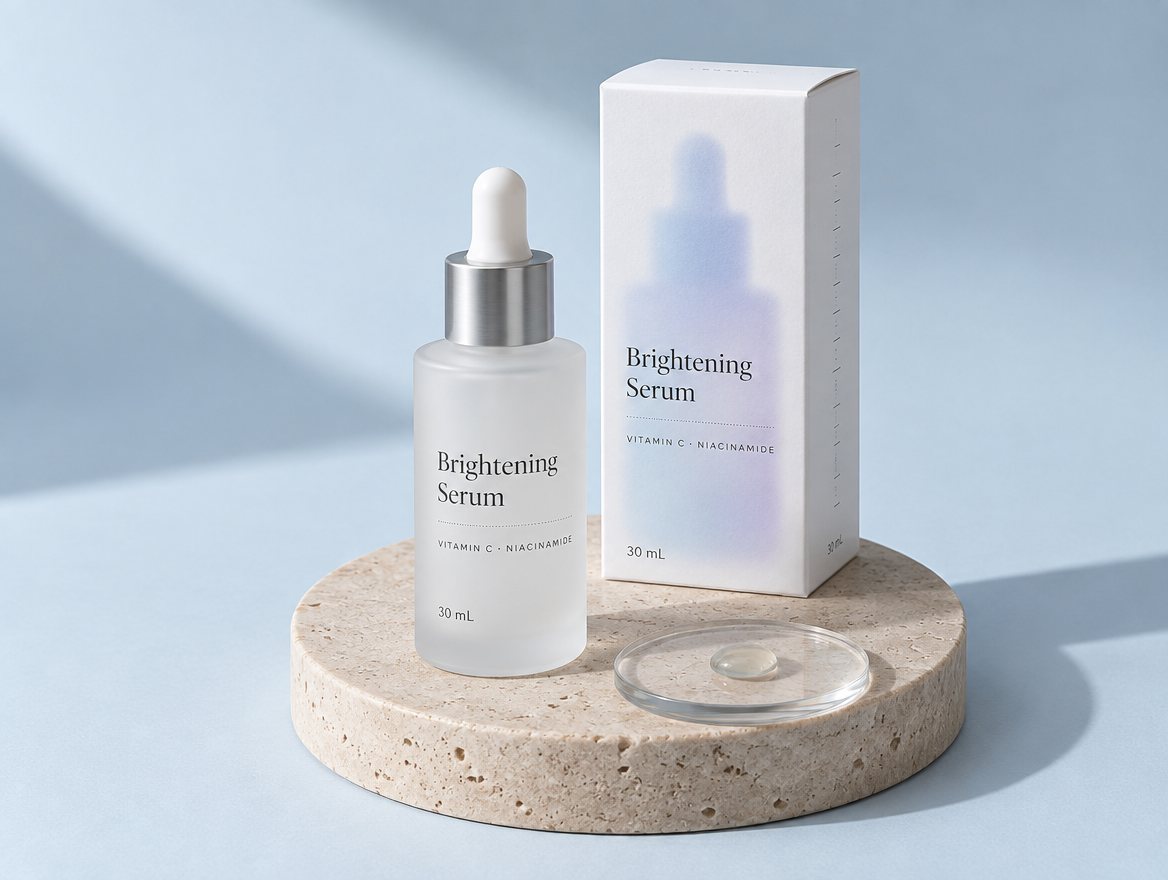
A private label PDRN serum is a serum built around PDRN (polydeoxyribonucleotide), purified DNA fragments usually taken from salmon, that a manufacturer makes and you sell under your brand. On the ingredient list it normally reads Sodium DNA. At KoreanOEM a serum starts from $3.70 per unit at 500 units, with lab samples in about two weeks.
What PDRN means in skincare
PDRN stands for polydeoxyribonucleotide, a mixture of DNA fragments of different lengths. The classic material is purified from the sperm cells of salmon trout (Oncorhynchus mykiss) or chum salmon (Oncorhynchus keta) in a process designed to remove proteins and peptides. The fragments range from roughly 50 to 1,500 kDa in molecular weight.
So the "salmon sperm" nickname describes the source, not what goes into the bottle, which is a highly purified DNA powder or solution. In medicine, PDRN is a registered drug studied mainly for tissue repair and wound healing, and researchers link its effects to adenosine A2A receptors on cells and to the recycling of nucleotides by the body.
PDRN and PN are close cousins
You will also see PN, short for polynucleotides. Both come from DNA, and PN usually means longer chains. Papers use the two names loosely, and a 2025 review proposed a cutoff at 1,500 kDa to tell them apart. On a supplier sheet, "PDRN" or "PN" means little until you see the stated fragment size.
Why PDRN became a K-beauty trend
The trend started in dermatology clinics, not on store shelves. Korean clinics use injectable "skin boosters" made from DNA fragments, and in a survey of 235 Korean board-certified dermatologists familiar with skin boosters, 88% said they performed polynucleotide injections. The treatments became known as "salmon injections", and skincare brands carried the name into serums, ampoules, creams, toners and sheet masks.
Keep the two worlds apart. Injectables are regulated as medicines or medical products and are placed under the skin by a clinician. A PDRN serum is a cosmetic that stays on the skin surface. It is not a needle-free version of the treatment, and selling it as one invites trouble with regulators and with customers who expect clinic results.
What the evidence shows for topical PDRN
Most human evidence for PDRN comes from wound healing and from injected or procedure-assisted use. A 2026 systematic review found just seven randomized trials of PN or PDRN for skin rejuvenation, scars and wounds, with 183 participants in total. In every trial the material was injected, applied after microneedling or laser, or put on a wound, and the authors called the evidence limited by small samples and mixed protocols.
Evidence for a cosmetic on intact skin is thinner and newer. A 2026 randomized, double-blind, split-face study compared a 0.1% PDRN eye cream with a 0.1% retinol eye cream in 31 women for 28 days and reported larger gains in eye-area wrinkle measures on the PDRN side, with good tolerability. That is encouraging, but it is one small study of one formula over four weeks.
Delivery is the other open question. DNA fragments are large, charged molecules, and getting them through the skin barrier is still an active research topic. For a brand this points to two habits: write claims about how skin looks and feels (hydrated, smoother-looking, comfortable), and test the finished serum on people if you want anything stronger.
How PDRN appears on the label, and what "10,000 ppm" means
"PDRN" is a marketing name, not an ingredient name. Salmon PDRN is usually listed by its INCI name, Sodium DNA, which the EU CosIng database records as the sodium salts of deoxyribonucleic acid, with a skin conditioning function. Some plant-derived materials are listed as Hydrolyzed DNA or under a plant name. The INCI name does not reveal the source, so ask the supplier for a statement of origin.
Concentration claims need the same care. 10,000 ppm is 1%. PDRN raw materials are sold both as dry powders and as pre-diluted solutions, so "10,000 ppm PDRN" can mean 1% pure DNA or 1% of a solution that holds far less.
The ingredient list gives a clue: in the EU and the US, ingredients above 1% are listed in descending order, and those at 1% or less may follow in any order. When the DNA ingredient sits at the very end of the list, the DNA itself is almost certainly at 1% or less.
EU claim rules add a second test. An ingredient's properties must not imply that the finished product has them when it does not, and a claim that carries an ingredient benefit over to the product needs evidence, such as showing the ingredient is present at an effective concentration. The honest fix is simple: say what your number refers to, keep batch records that prove the input amount, and base benefit claims on tests of the finished serum.
Salmon, vegan and "plant PDRN"
Plant PDRN is DNA purified from plants or plant cell cultures, such as ginseng roots or peony, and there are also versions made from microalgae and bacteria. The appeal for vegan brands is obvious. The science is younger: a 2023 study of ginseng-derived PDRN tested cells and a lab-grown skin model, not people, and a 2026 review of plant-derived PN and PDRN says the evidence is mostly preclinical and should not be read as clinical equivalence to animal-derived PDRN.
If you print "vegan PDRN", get the supplier's documents showing that the material is DNA and not only a plant extract, its botanical source, and that no animal-derived materials were used. If you use salmon PDRN, do not call the product vegan, and expect customers to ask about the fish source.
How a PDRN serum or ampoule is made as a private label product
- Brief. Format (serum, ampoule or cream), texture, target retail price, markets and the claims you want.
- Base formula. A library formula is the fastest route; a custom formula is built from your brief. Here is how custom skincare formulation works.
- PDRN material. Source, form, the supplier's certificate of analysis and the input level, agreed in writing.
- Lab samples. You test, send written feedback and approve a sample before production.
- Packaging. A glass dropper or an airless pump for a serum; smaller bottles or vials for an ampoule.
- Tests. Stability in the final pack, a preservative challenge test and a patch test. See what stability testing checks.
- Labels, documents and production. Compliant labels, the full INCI list and your market documents, then filling, QC and shipping.
A PDRN cream or gel cream follows the same steps; only the base and the container change. At KoreanOEM a private label serum starts from $3.70 per unit at 500 units, about $1,850 for the run, and drops to about $2.96 per unit at 1,000. A private label ampoule starts from $4.95.
Those figures assume a library formula, a stock container and a one-color label. A higher PDRN level, custom packaging or extra tests appear as separate lines in the written quote. Plan on about 10 weeks from brief to delivery with a library formula and stock packaging, or 12 to 16 weeks for a custom formula.
Questions to ask before you approve a PDRN sample
- Which source is it (salmon, trout or plant), and which INCI name will appear on the label?
- Is the raw material a powder or a solution, and how much DNA does it contain?
- What is the input level in my formula, and how is any ppm figure on the box calculated?
- What fragment size or molecular weight range does the supplier state?
- Has the formula passed stability testing in my final packaging, and a challenge test?
- Which claims rest on tests of this product, and which only on supplier data about the ingredient?
Clear answers give you a product you can defend in front of a retailer, a regulator or a skeptical customer. To compare textures before you commit, ask for samples.
Frequently asked questions
What does PDRN mean in skincare?
Is PDRN really made from salmon sperm?
Does a PDRN serum work like PDRN injections?
Is vegan PDRN the same as salmon PDRN?
How much does it cost to make a private label PDRN serum?
Sources
- Squadrito F. et al., Pharmacological Activity and Clinical Use of PDRN, Frontiers in Pharmacology, 2017
- Marques C. et al., From Polydeoxyribonucleotides (PDRNs) to Polynucleotides (PNs), Biomolecules, 2025
- Rho NK et al., A survey on the cosmetic use of injectable polynucleotide among Korean dermatologists, Journal of Cosmetic Dermatology, 2024
- Alhussain AM et al., Polynucleotides and Polydeoxyribonucleotides for Skin Rejuvenation, Scar Prevention and Wound Healing: a systematic review of randomized trials, Cureus, 2026
- Ye R. et al., Topical medium-length PDRN in photodamaged skin, PLoS One, 2026
- Lee KS et al., PDRN isolated from Panax ginseng adventitious root, Molecules, 2023
- Kim HJ et al., Plant-derived polynucleotides and PDRN in skin biomaterials, Journal of Functional Biomaterials, 2026
- European Commission CosIng database: SODIUM DNA
- Commission Regulation (EU) No 655/2013 on common criteria for cosmetic claims
- Regulation (EC) No 1223/2009 on cosmetic products, Article 19 (labelling)
- 21 CFR 701.3, Designation of ingredients (US)
- FDA: Is It a Cosmetic, a Drug, or Both? (Or Is It Soap?)