How are sheet masks made? From the sheet and essence to a sealed pouch
A sheet mask looks simple, but it is three products in one: a fabric, a liquid and a pouch. Here is how each one is made and put together, and what a brand decides along the way.
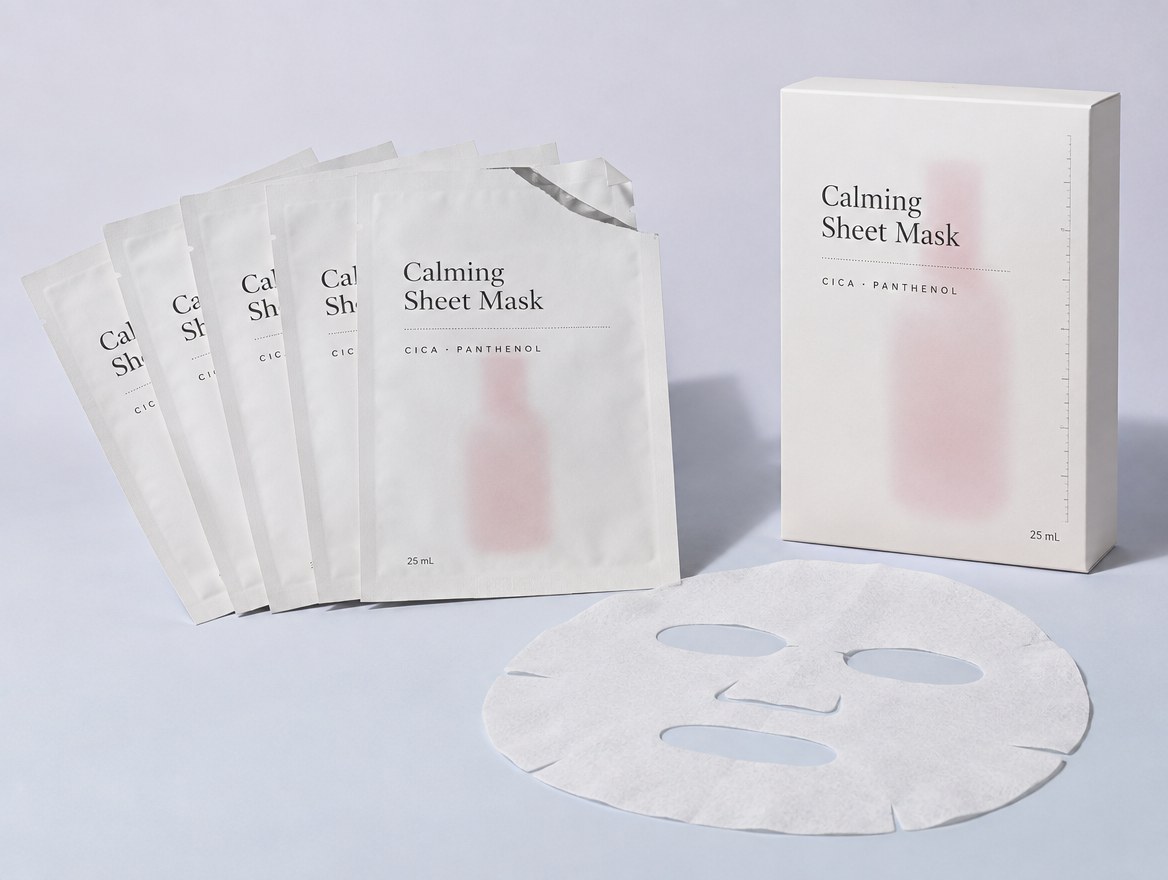
Sheet masks are made from three parts that meet on a filling line. A nonwoven sheet is die-cut into a face shape and folded, a water-based essence is mixed in a tank and tested, and both go into a printed foil pouch that is filled with roughly 20 to 30 mL of essence, heat-sealed and checked.
What sheet masks are made of
Every sheet mask has three parts: the sheet, the essence and the pouch. The sheet is a nonwoven fabric, meaning fibers bonded into a web instead of woven or knitted. The essence is a water-based serum, and the pouch is a laminated foil bag that keeps out light and air and keeps the essence from drying.
| Sheet | Made from | On the face |
|---|---|---|
| Cotton | Cotton fibers | Soft, thicker, more opaque |
| Cupra (cupro) | Regenerated cellulose from cotton linter | Very thin, clings, turns almost clear |
| Lyocell | Cellulose spun from wood pulp | Smooth, soft, absorbent |
| Bio-cellulose | Cellulose grown by bacteria | Gel-like, close fit, costs more |
| Hydrogel | A cast gel of natural gums, water and glycerin | Cooling and jelly-like, a separate product |
Blends are common too, and some sheets use bamboo or charcoal fibers.
Cupra, lyocell and bio-cellulose in plain words
Cupra, also called cupro, is regenerated cellulose made from cotton linter, the short fibers left on cotton seeds after ginning. One maker, Asahi Kasei, sells a continuous-filament cupro sheet that it says absorbs up to 13 times its own weight in liquid. It clings well and turns nearly transparent on the face.
Tencel is Lenzing's brand for its lyocell, a cellulose fiber spun from wood pulp. Lenzing controls the name through product licenses, so print "Tencel" on a pouch only if the sheet supplier can document genuine branded fiber and the license is in place. Otherwise "lyocell" is the accurate word.
Bio-cellulose is not spun at all. Bacteria of the Komagataeibacter group build a cellulose film in a fermentation broth, often based on coconut water, and the film is then purified and cut. It fits closely and feels like a gel, but cost and scale-up remain its weak points, and that shows in the unit price.
The essence: what goes into the pouch
The essence is made like any water-based serum: water, humectants such as glycerin or butylene glycol, a light thickener, the actives and a preservative system. It is mixed in a tank and released for filling only after checks on appearance, pH, viscosity and microbiology. Because it is mostly water, the essence still needs a preservative system, checked with a challenge test like other water-based products, even though each pouch is used once.
Most Korean face masks carry roughly 20 to 30 mL of essence, but more is not automatically better. In a 2022 study of 139 people wearing commercial masks for 15 minutes, about 4.8 g of essence reached the skin on average, and much of the rest stayed in the sheet and pouch. The same study saw exposure to the preservatives rise sharply at 25 minutes and beyond.
A 2024 trial found that wearing masks for longer than 25 minutes brought more dryness and redness. Labels usually say 10 to 20 minutes, which fits both findings, so the directions on your pouch deserve as much thought as the essence.
Step by step on the factory floor
- Cutting. Rolls of nonwoven are die-cut into the face shape, with openings for the eyes, nose and mouth and often small slits so the sheet follows the chin and forehead.
- Folding. The sheet is often laid on a thin protective film or mesh that helps it unfold cleanly, then folded by machine to the pouch size.
- Pouching. The folded sheet slides into a printed pouch that is sealed on three sides and open on the fourth.
- Filling. A dosing nozzle adds a measured amount of essence, and the sheet soaks it up inside the pouch. Some lines dose the essence onto the folded sheet first; the result is the same.
- Sealing and coding. The open end is heat-sealed and printed or embossed with the lot number and, where needed, a date.
- Checking and packing. Pouches are weighed and seal-checked, then boxed in fives or tens and packed into cartons.
Hydrogel masks are a different product
Hydrogel masks are made on another line. A mix of water, glycerin and gelling gums such as carrageenan and locust bean gum is heated to about 60 to 90 °C, spread on a film, cooled until it sets, cut into shape and packed with essence. That is why hydrogel face masks and eye patches are quoted as their own product rather than as a sheet option; see private label hydrogel patches.
Quality checks that matter
- Bulk essence: appearance, pH, viscosity and a microbiology result before filling starts.
- Fill weight: an underfilled mask dries out on the face, and an overfilled one spills when opened.
- Seals: sample pouches are squeezed or pressure-tested, because a weak seal lets essence leak or evaporate in transit.
- Visual checks: fold position, sheet centering, print quality, lot and date codes.
- Stability in the final pouch: color, odor and pH of the essence over time, and how the sheet holds up in it. Here is how cosmetic stability testing works.
Why pouches set the minimum order
A lab can make essence in almost any batch size, and sheets come off large rolls. The pouch sets the floor. Printed pouch film runs on presses that need plates or cylinders and setup film for each design, then it is laminated and converted into pouches, so converters work in long runs. The filling line also needs a changeover and cleaning for every essence and pouch design.
That is why minimums usually apply per design, and why five scents in five pouches cost more to launch than one. At KoreanOEM the minimum is 1,000 masks. A sheet mask starts from $0.55 per mask, about $550 for 1,000, and the estimate drops to about $0.40 each at 5,000.
Like every starting price, it assumes a library formula, stock packaging and a one-color label. The sheet material, essence volume, pouch finish and a printed box are itemized in the written quote. For a first test, ask whether a smaller trial run with a library essence is possible.
What a brand decides
- Sheet: cotton, cupra, lyocell or bio-cellulose, and the cut, either one piece or an upper and lower pair.
- Essence: the base, a watery or slightly gel texture, fragrance or fragrance-free, and the volume per mask.
- Claim: hydrating, calming or brightening the look of skin, and the test or data behind it.
- Pouch and box: size, finish, colors, tear notch, and five or ten masks per box.
- Label text: wear time, directions, warnings, the ingredient list, the lot number and a date where required.
- Markets: an FDA MoCRA listing for the US, a CPNP notification and an EU Responsible Person for the EU; here is what each market asks for.
When you compare sheet mask manufacturers in Korea, ask to see the same essence on two or three sheets, the pouch minimum per design, and the stability and challenge test reports for the finished mask. Our options are on the private label sheet mask page, and you can ask for samples of the sheets you are considering.
Frequently asked questions
What are sheet masks made out of?
How much essence is in a sheet mask?
Why is the minimum order higher for sheet masks than for serums?
How long should you leave a sheet mask on?
Do sheet masks need an expiration date?
Sources
- Asahi Kasei: Bemliese for sheet and face mask materials
- Lenzing: Only One TENCEL Brand, trademark protection and product licenses
- Bhadra L. et al., Bacterial cellulose in cosmeceuticals: a review, International Journal of Biological Macromolecules, 2025
- Bacterial cellulose membranes grown in coconut water, Gels, 2026
- WIPO Patentscope WO2016076575: Hydrogel mask pack composition and preparation method
- Zhou L. et al., Investigation of actual exposure to facial sheet mask, Scientific Reports, 2022
- Wang Y. et al., Short-term skin reactions following different ways of facial sheet mask usage, Journal of Tissue Viability, 2024
- Cosmetics Europe: Guidelines on Cosmetic Product Labelling, 2011
- FDA: Shelf Life and Expiration Dating of Cosmetics